LinkedIn Algorithm 2026: What Has Really Changed — and What It Means for Your Content
Written by
Niklas Götz
April 3, 2026

The New Algorithm — What's Happening Under the Hood?
LinkedIn has fundamentally rebuilt its feed algorithm — and we're not talking about minor tweaks. The entire architecture behind it is new, based on insights straight from LinkedIn's engineering team.
In this article, we break down what changed technically, what used to work and no longer does, and what this concretely means for your content strategy.
How the New Algorithm Works
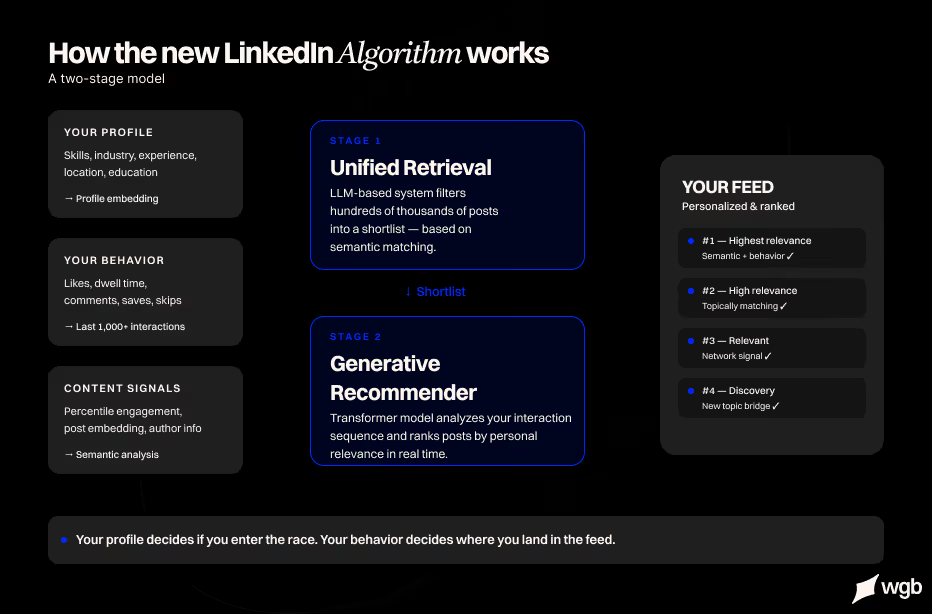
Your Profile Is Your Algorithm Key. Your LinkedIn profile isn't just your digital business card. It's one of the most important signals the algorithm uses to decide what content you see — and who sees yours. The algorithm builds a profile embedding from your industry, skills, experience, location, and education — a mathematical fingerprint of your professional identity.
A poorly maintained profile isn't just bad for your image — it's a weak signal for the algorithm.
Stage 1: Unified Retrieval — "Who even qualifies?"
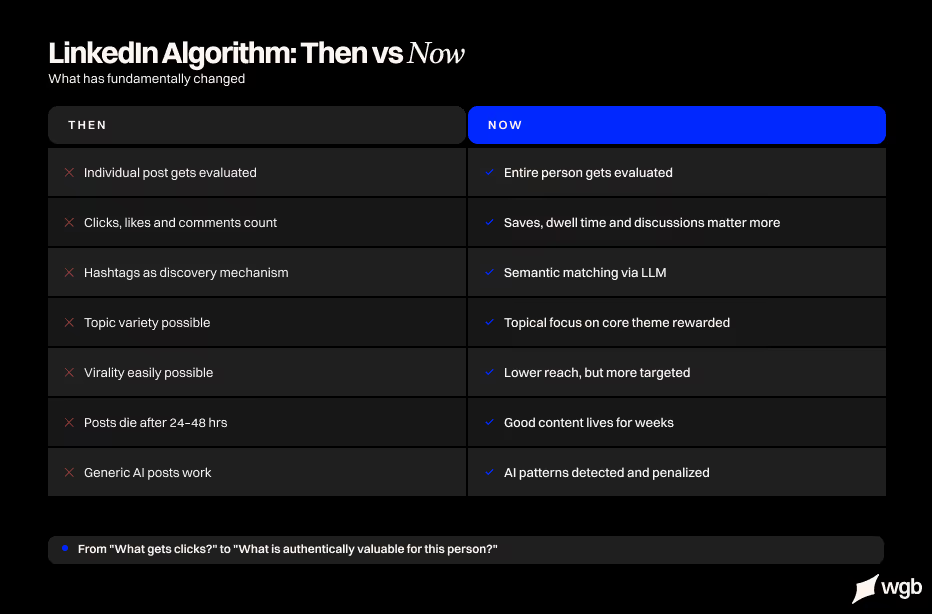
Previously, several separate systems ran in parallel. Now it's a single, LLM-based system. The algorithm now understands content semantically, not just by clicks and likes. An electrical engineer interested in Small Modular Reactors will now see that content — because the system understands the professional relationship.
Stage 2: Generative Recommender — "In what order?"
LinkedIn now uses a transformer model that analyzes your last 1,000+ interactions in chronological order. Likes, comments, dwell time, return visits, and what you skipped — everything is treated as an ordered sequence. Your profile decides if you're in the race. Your behavior decides where you land.
Key Signals:
- Profile data: industry, skills, experience, location, education
- Engagement history: dwell time, return visits, skipping behavior
- Content signals: engagement as percentiles, recency, post embeddings
Age and gender do NOT factor in. LinkedIn emphasizes: "Posts from different creators compete on equal footing."
The Percentile Detail: A post with 50 likes on a small profile can be weighted just as strongly as one with 5,000 likes on a large profile. Relative performance counts, not absolute reach.
Real-Time Updates: Your feed adapts within minutes. If you start clicking through sales content in the morning, you'll see more of it that same morning.
The New Algorithm — What's Happening Under the Hood?
Through the two-stage model, topical consistency takes on a whole new weight. If you jump around thematically — a personal childhood story today, a Google Ads tip tomorrow, a remote work meme the day after — you create a diffuse signal. And a diffuse signal means the algorithm can't categorize you well.
But does that mean storytelling is dead? No. Definitely not. The algorithm doesn't evaluate the format. It evaluates topical coherence. You can do storytelling, entertainment, or educational content — as long as it stays thematically within your area of expertise.
Examples:
- Fits: Google Ads agency tells a client story about tripling ROAS. Storytelling, but thematically consistent.
- Diffuse signal: Google Ads agency posts about their morning routine and meditation.
- Fits: SaaS founder shares a failed product decision. Personal, but professionally relevant.
- Diffuse signal: SaaS founder posts a ski trip photo with "Work hard, play hard."
The rule of thumb: Format is free, topic should be focused.
How Do You Still Reach Your ICP?
The retrieval system matches semantically, not by job title. If a D2C founder has "performance marketing" as a skill and regularly interacts with marketing content, your Google Ads content will be shown to them — even if they're not a Google Ads marketer themselves.
But it depends on how you frame your content. Writing only in specialist jargon creates a very narrow embedding. Writing about the results and business implications creates a broader embedding that matches with your actual target audience.
The key insight: It's not WHAT you post that determines your audience, but HOW you frame it. Tell it from your target audience's perspective, not from your peers' perspective.
Do's and Don'ts for Your LinkedIn Strategy
Do's:
- Write about what you actually know. The algorithm understands the semantic connection between your profile and your content. Depth beats breadth.
- Invest in dwell time, not click counts. Content where people stop and read is rewarded.
- Be consistent — 2-4x per week is enough. The system needs a consistent pattern to categorize you properly.
- Write naturally — no keyword stuffing. 3-5 relevant hashtags are plenty.
- Have real conversations in the comments. A thoughtful comment is worth more than three posts without substance.
- Use the power of return visits. Frameworks, templates, and checklists create this signal.
- Optimize your profile — seriously. Skills and headline are direct inputs for your profile embedding.
- Frame content for your target audience, not peers. Use their language, address their problems.
Don'ts:
- No engagement bait. Anything forcing superficial interaction is now penalized.
- No engagement pods. LinkedIn detects these patterns and downranks content.
- No automation tools. Anything that isn't you yourself is a risk.
- No generic thought leadership. The algorithm rewards specific, experience-based insights.
- No video-text mismatches. Visual content should match the text.
- Don't rely on hashtags for discovery. The algorithm understands content semantically.
Bonus: Watch what you consume. The algorithm also learns from your passive behavior. You train your feed with every scroll — so train it in the right direction.
Conclusion
If you take a step back and look at the changes as a whole, the direction is clear: LinkedIn is shifting from "What gets clicks?" to "What is authentically valuable for this specific person?"
The two-stage model — first filter semantically, then rank sequentially — is technically sophisticated, but the consequence for content creators is surprisingly simple:
Professional depth × Consistency × Authenticity = Algorithmic reach

There are no hacks, shortcuts, or pods that can replicate this — just good content for the right people, thematically focused, regularly published, and an algorithm that's finally smart enough to recognize and reward that.
That's good news for anyone with real expertise who is willing to share it. And bad news for anyone who built their success on tricks, pods, and bait.
The rules have changed. For the better.
Sources: Tim Jurka, "Updates to LinkedIn's Feed: Focusing on Authentic & Relevant" (LinkedIn Pulse, March 2026); LinkedIn Engineering Blog, "Engineering the Next Generation of LinkedIn's Feed" (2026)